AI Predictive Maintenance for the 2030 Jeep Gladiator
A concept for how AI-powered predictive maintenance could help Jeep Gladiator drivers understand what's happening to their vehicle, not just alert them to problems, designed around Jeep's most infamous issue: the "death wobble."
Context & Problem
There's a term Jeep owners use with a sort of dark humor: the "death wobble." At high speeds and after hitting a bump or pothole, the front end and steering wheel shake violently. Most heavy-duty vehicles are susceptible to it, and once I found that out, I knew I'd found a project area with real potential.
Over four months in a sponsor studio, Stellantis's UX team challenged me to explore how AI could shape the future of vehicles. I chose to focus on the area I thought could make the biggest difference: the Gladiator's most infamous maintenance issue.
How might we… ensure safety for Jeep Gladiator drivers ahead of their maintenance issues?
Empathize
I. What Exists
I ran a competitive analysis on four brands already offering predictive maintenance: Ford, GM, BMW, and Mercedes.
Across all four, the core mechanics were the same:
- Sensors feed a cloud platform
- Algorithm flags a developing issue
- Driver gets a notification
III. A Growing Market
Discovering Jeep owners' persona led me to research a growing DIY repair market, which has increased 5.96% annually since 2020, with owners who self-maintain saving ~$3,993 a year. For this audience, DIY wasn't a niche behavior, it was a defining one.
II. Who Owns Jeep Gladiators?
- Majority: male, 30-50 years old
- Bought the vehicle for off-roading and modification
- Ownership tends to be hands-on: many already do their own oil changes, brake jobs, and suspension work
IV. User Needs
Synthesizing the user interviews and research, three needs surfaced repeatedly:
- Early awareness
- Building understanding of vague warning signs
- Control over their own maintenance
The Gap
No existing predictive maintenance systems support the hands-on engagement Jeep drivers want.
Design Decisions
Swipable Widget
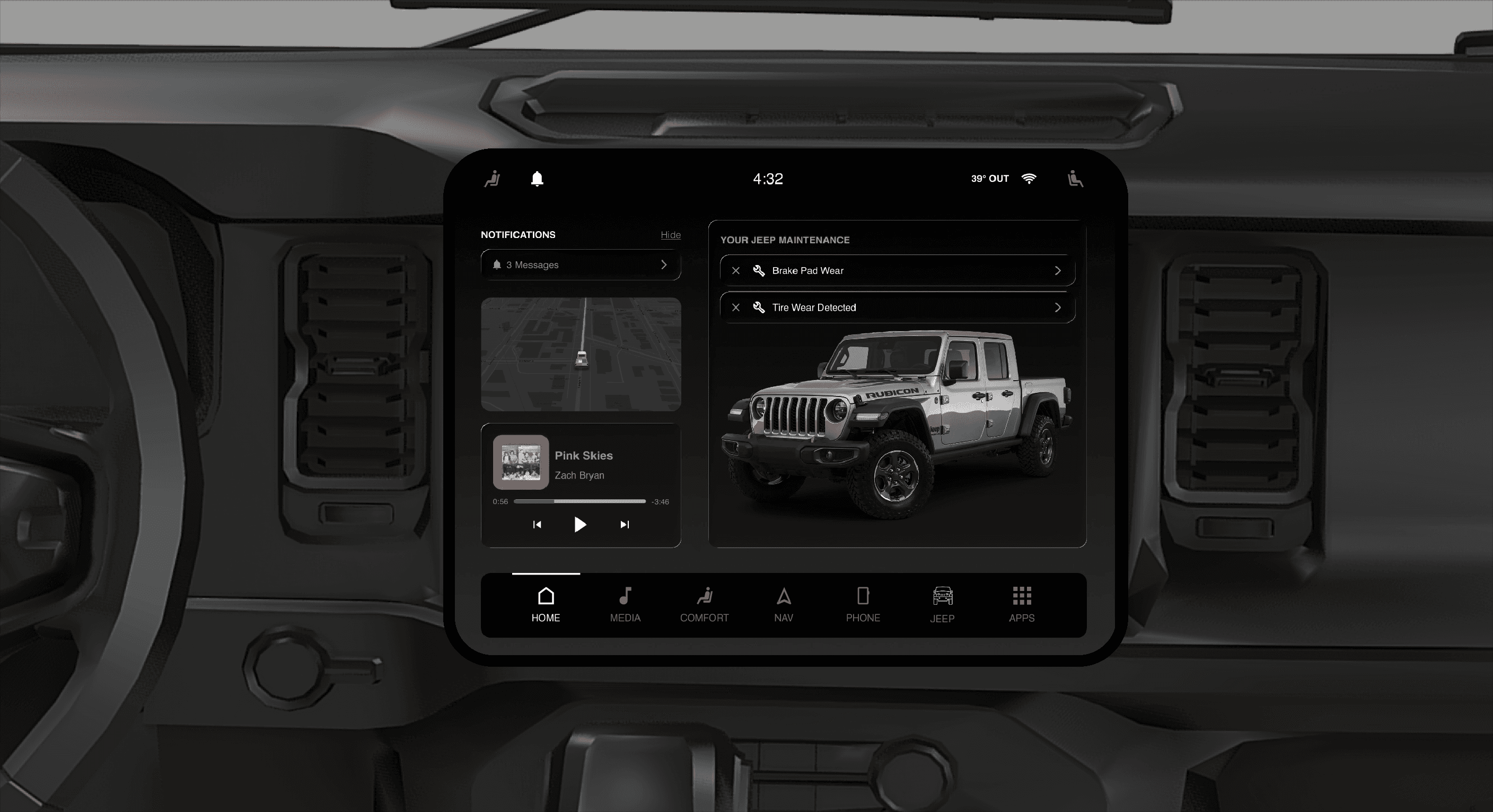
A swipeable widget on the center display surfaces a color-coded maintenance page (green, yellow, red) only during safe moments like parking, while truly urgent issues route straight to the instrument cluster.
AR Car Scanner
JeepView is an AI-powered AR feature where a driver points their phone at any part of the vehicle to get an explanation, how-to videos, and a path to service if flagged, turning maintenance intimidation into understanding.

Calendar Integration
Turning understanding into action, it suggests service windows based on issue severity and the driver's schedule, keeping the booking flow off the center display to protect the in-car experience.

Final Design
Challenges & Setbacks
- First time designing for vehicle displays, new territory to navigate.
- Testing limited to Stellantis's UX team and classmates, not the actual target user group in a real vehicle.
- Early prototype faced pushback for surfacing “embarrassing car maintenance issues” on the home page, leading to a reworked hierarchy and multi-click process so drivers access that info only when searching for it.

Outcome & Reflection
With more time, I would go deeper into validating design solutions, especially testing JeepView with real users on real vehicles. Given the limitations and time constraints, I'm proud of what this project achieved: a system that goes beyond warning drivers, and actually helps them understand what's happening and gives them a clear path to act.